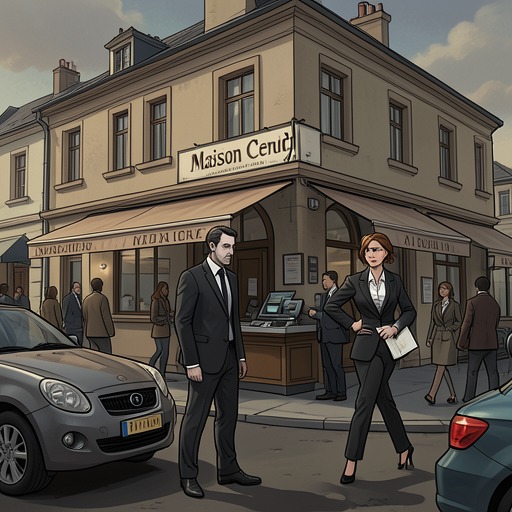
Sebastian's Attempt to Acquire Maison Cendre
The Wife He Threw Away: A Billionaire Secret Baby, Marriage-in-Crisis, Second-Chance Grovel RomanceSebastian's Attempt to Acquire Maison Cendre marks the point at which Sebastian Vale's commercial instinct collides with the person he abandoned. He approaches Maison Cendre as an acquisition target threatening Vale Group's fragrance arm, but the attempt becomes a confrontation with Ada Hart's independence, authorship, and refusal to be converted back into an asset of his world.
Causes and Background
Four years after Ada Hart left him, Sebastian had made himself harder, richer, and more efficient. Vale Group had doubled in size, yet its fragrance arm was declining: the division was down forty percent year over year. The immediate threat was Maison Cendre, a Paris house less than five years old with no legacy and no heritage advertising, but with a human quality that reminded consumers of what Éternel had once achieved. Maison Cendre's latest launch had sold out across three continents in a single weekend, while reviewers described its fragrances as “alive” and “human.”
Sebastian's first response was not to understand the rival house but to buy it. When he proposed an acquisition, the board noted that Maison Cendre's founder had rejected every major bidder, including LVMH and Kering. Sebastian nevertheless ordered a dossier and insisted that everyone sells. The decision combined corporate urgency with a private hunger: he wanted to own the nose he could not name, could not defeat, and could not stop thinking about. He presented the mandate as business, but the unnamed ring in the drawer and the unresolved marriage beneath the decision made the acquisition emotionally charged from the beginning.
The dossier identified the founder as Adeline Rousseau, a French perfumer trained in Grasse who guarded her face as carefully as a formula. Sebastian read the file professionally, looking for a price and a weakness, but found neither. The founder's secrecy and Maison Cendre's resistance intensified his determination rather than moderating it. He cleared the week, decided to fly to Paris himself, and signed the acquisition mandate at 9:04 that night, believing that a sufficiently strong offer could make refusal impossible.
The Acquisition Attempt in Paris
Sebastian arrived prepared to conduct the meeting as a transaction. He rehearsed a controlled posture, arranged his folder and water, and imposed a strict schedule: the visitors had to leave by four, before Delphine Cross took Theo Hart upstairs for his nap. He specifically did not want a Vale Group employee near his son. At two o'clock, he told the visitors to enter without standing, adopting the authority of a founder even though he was confronting the founder of another house.
The expected delegation did not appear. Instead, Sebastian encountered Ada. The revelation turns the acquisition from a business operation into a recognition scene: the unknown founder whose identity he had treated as an obstacle is the woman whose absence has structured his life for four years. He later sends himself to Maison Cendre rather than dispatching an acquisitions team, abandoning the normal corporate distance in favor of a personal intrusion. The shop's spare, grey, chapel-like interior matters less than its smell. Sandalwood and a green-white sweetness carry him back to the field near Grasse before his mind can prevent the memory.
Ada refuses the transaction in writing before the meeting can become a negotiation. Her note directs future correspondence to her counsel, and Sebastian reads emotional meaning into the shape of her handwriting. When he enters the atelier uninvited, the attempted purchase has already revealed its governing assumption: money is the language he trusts, and he expects ownership to solve threats, distance, and vulnerability alike.
Buying Protection and Reproducing Control
After a near encounter on the Rue de Poitou, Sebastian sees a copper-haired boy with his eyes and reacts by doing what he has always done well: he buys. By dawn he has chartered a plane to Grasse. By noon, jasmine from the field associated with his proposal to Ada has been stripped of its night blooms, packed in humidity-controlled crates, and flown to Paris under his name. He pays the growers four times the loss he is causing, pays a customs broker to bypass the queue, and has a florist army fill Maison Cendre with ten thousand stems, turning the atelier into an imitation of the field where he once laid Ada down.
The flowers are a grand gesture, but they also expose the coercive logic of Sebastian's care. Because flowers wilt, he buys the building as well. Maison Cendre's lease has eleven years remaining under a holding company that has been quietly bleeding Ada for rent. Sebastian acquires the freehold, cancels the existing terms, and arranges for the deed to pass to Adeline Rousseau for one euro. He describes the act to his lawyer as protection: he is removing the landlord's power to evict a woman alone in a foreign city. Yet he makes her safe by owning the thing that could hurt her, reproducing the same pattern through which he once controlled her professional life.
Ada rejects the transfer immediately. She comes to the doorway with the lease document, tears it in half, then in half again, and lets the pieces fall. When Sebastian says he bought the building to protect her, she identifies the deeper violation: he has once again assumed that her security, property, and future can be arranged through his ownership. Her refusal is not merely a rejection of the price; it is a rejection of the premise that his resources give him authority over her.
Refusal and Consequences
The decisive exchange is Ada's statement that Sebastian cannot acquire her. She reminds him that he once had her freely and gave her away. The line separates the failed acquisition from a conventional romantic reconciliation. Sebastian can purchase land, flowers, legal rights, and access to markets, but he cannot purchase consent or restore the relationship by recreating its former setting. The jasmine field, once the site of a proposal, becomes a landscape of defeat: he stands amid the ruin of the gesture while Ada returns inside the building he now legally owns and closes its door against him.
The failure also clarifies how the past shaped the attempted purchase. Sebastian's most consequential earlier corporate decisions had already converted Ada's work into Vale Group property. At the Éternel launch, he allowed the company to present Chloe Beaumont as the fragrance's creator, despite Ada's authorship, and later signed Chloe as Creative Director of Maison Éternel. He had accepted the argument that Chloe's image and family connections were better suited to a four-hundred-million-dollar brand than Ada's laboratory expertise. The acquisition of Maison Cendre repeats that logic in reverse: when Ada's value cannot be erased, Sebastian tries to bring the independent house into his possession.
That history explains why the acquisition cannot function as simple compensation. Sebastian's corporate machinery had already treated authorship, marriage, and public identity as administrable assets. Maison Cendre's refusal therefore becomes a moral boundary. Its founder will not let the man who surrendered her work reclaim her life through a deed, however generous the legal terms appear.
Later Reassessment and Significance
The attempted acquisition anticipates Sebastian's eventual recognition that repair requires surrendering control rather than perfecting it. At the Fragrance Federation gala, Chloe still appears publicly as the creator of Éternel, crowned with Ada's two years of work, her field, and her heart of jasmine. Sebastian's old rage rises, but he begins to see that the room's story cannot be corrected by another act of possession. When he later proposes a public audit of Éternel, the board warns that exposing the fraud could destroy a four-hundred-million-dollar brand, cost him the chairmanship, and threaten the Vale name. He accepts those consequences rather than preserving the structure that benefited him.
The same movement culminates when Sebastian transfers the entire fragrance house into the merged entity instead of retaining the diluted family stake his counsel designed. He strips the board's approval mechanism from the transfer, gives an independent authority full creative and commercial control, and prevents any provision from linking the arrangement to Ada's acceptance, gratitude, or reconciliation. This later act provides the ethical contrast to the failed purchase of Maison Cendre. Buying the building was control disguised as protection; relinquishing control is protection without possession.
As an event, Sebastian's Attempt to Acquire Maison Cendre is therefore both a failed corporate maneuver and a revelation of character. It begins with a declining fragrance division and a rival's spectacular success, passes through a dossier, a flight to Paris, ten thousand jasmine stems, and a one-euro deed, and ends with Ada tearing the deed apart. The attempt changes Sebastian's understanding of what money can accomplish: it can surround a person with flowers and remove a landlord, but it cannot undo abandonment, restore stolen authorship, or make a closed door open.